Institutional Decay at Delhi Cooperative Tribunal: How Opaque Digital Infrastructure and Bureaucratic Hibernation Deny Justice in Housing Corruption
The Delhi Cooperative Tribunal (DCT) and the Office of the Registrar Cooperative Societies (RCS) operate as opaque, dysfunctional administrative entities that deny citizens access to justice by intentionally neglecting basic digital infrastructure and statutory disclosure mandates under Section 4 of the RTI Act. By refusing to publish officer names, contact details, cause lists, or judicial orders, these quasi-judicial bodies erect a wall of secrecy that shields delinquent bureaucrats facing corruption inquiries and protects illegal housing society syndicates. To uphold the rule of law and protect residents from systemic exploitation, these failing administrative setups must be permanently shuttered and replaced with independent, digitally transparent oversight mechanisms.
By Rakesh Raman
New Delhi | November 28, 2026
1. Digital Deficiencies and Denial of Justice at the Delhi Cooperative Tribunal
Digital transparency is not an optional luxury or administrative accessory; it represents a mandatory statutory obligation under Section 4 of the Right to Information (RTI) Act and serves as an indispensable prerequisite for public justice. When a quasi-judicial body systematically fails to provide digital case tracking, public cause lists, or operational disclosures, it actively disenfranchises citizens and converts public legal proceedings into opaque exercises of unchecked authority.
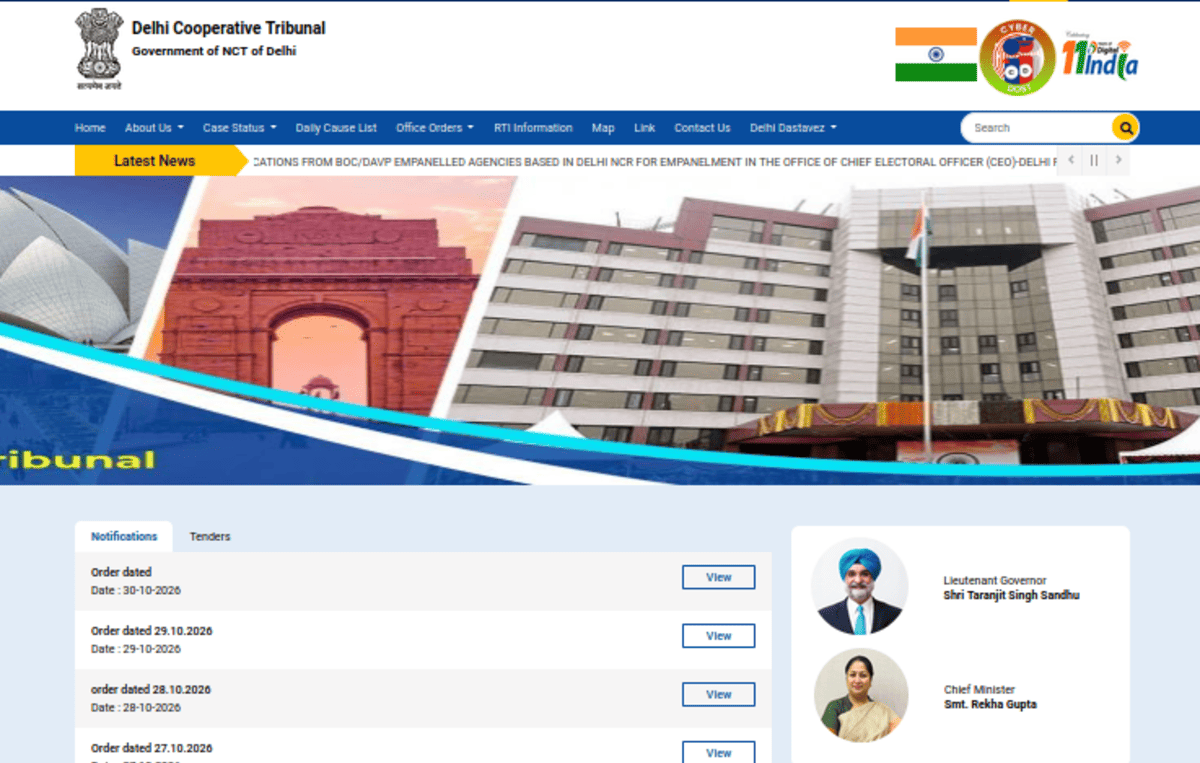
An administrative verification conducted on November 28, 2026—over eight months after journalist and RMN Foundation founder Rakesh Raman filed a formal complaint with the Lieutenant Governor of Delhi and the High Court Registrar General—proved that the Delhi Cooperative Tribunal (DCT) portal remains in complete disrepair. Unlike constitutional courts that publish judge profiles, hearing schedules, and cause lists online, the DCT operates like a secret forum where judicial officers function behind closed doors.
Key operational sections of the official DCT website, including the “Contact Us” and “RTI Information” pages, display the message “No content available.” The portal omits the names, professional designations, and backgrounds of Tribunal Members, Judges, the Registrar, and administrative staff. Furthermore, no official email addresses or telephone contact details are provided for public inquiries or electronic filings.
Official hearing notices issued to litigants frequently exhibit severe procedural flaws, including careless drafting, missing officer signatures, spelling errors, and a complete failure to state whether proceedings will be conducted physically or virtually. By omitting virtual hearing infrastructure and digital case tracking, the DCT denies procedural fairness to aggrieved citizens unable to attend opaque in-person hearings.
2. Administrative Paralysis and Bureaucratic Hibernation
The digital opacity at the tribunal level directly enables senior administrative officers to evade public accountability and engage in deliberate administrative stalling. Bureaucratic entities frequently deploy non-committal internal letters and unenforced deadlines to simulate compliance while neutralizing citizen complaints.
A clear demonstration of this administrative paralysis occurred following letter No. 1(168)/Misc./RCS/COMP-CC/2011/236, issued on October 19, 2026, by Registrar Krishna Kumar Singh from the Office of the Registrar Cooperative Societies (RCS). Addressed to the Chairman of the DCT, the letter referenced grievances submitted on the Chief Minister Jan Sunwai Portal and directed the tribunal to submit an Action Taken Report (ATR) within two days.
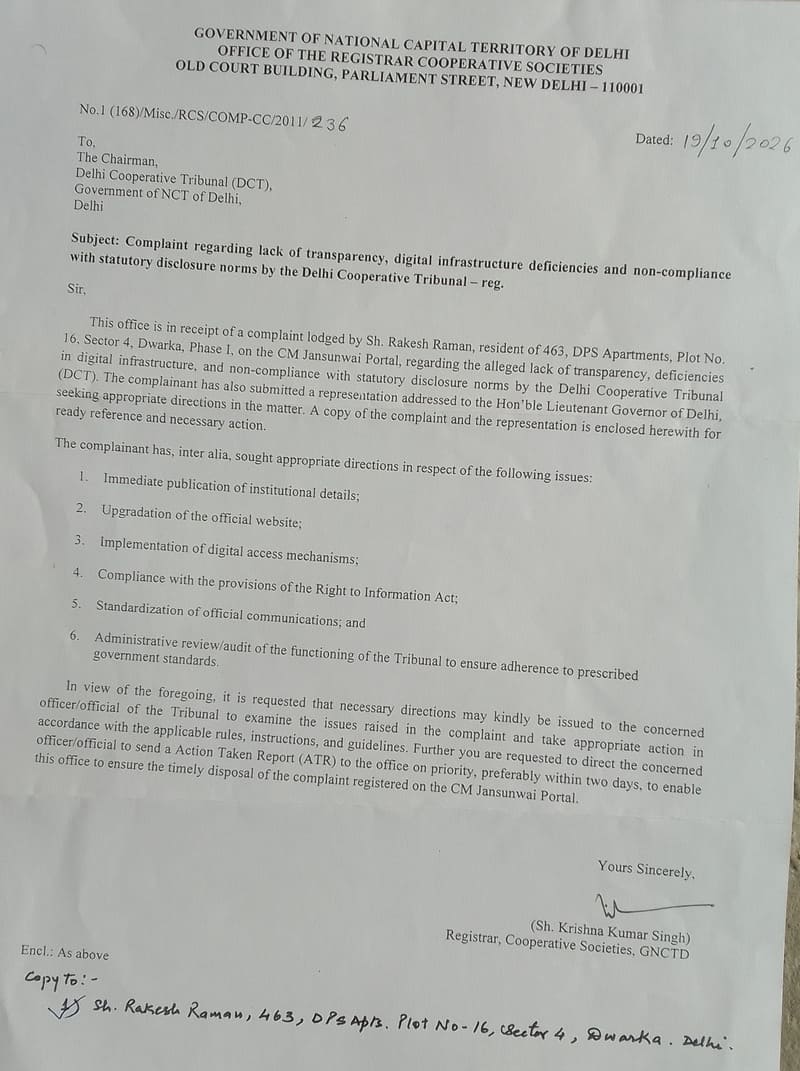
However, this communication was issued seven months after the initial March 2026 complaint, and the requested two-day ATR deadline was entirely ignored by the DCT. As of November 2026, the tribunal website remains completely uncorrected, demonstrating that subordinate bodies operate without fear of administrative oversight.
[ Clean House – Report Housing Corruption and Government Carelessness in Delhi ]
[ दिल्ली आवास और सहकारिता भ्रष्टाचार उजागर: ऑडियो विश्लेषण ]
This state of paper-based hibernation coincides with formal corruption inquiries initiated by the Ministry of Home Affairs (MHA) against key administrative figures, including Krishna Kumar Singh, IAS (AGMUT: 2012), Registrar Cooperative Societies, and Ashok Kumar, IAS (AGMUT: 2006), former Secretary (Cooperation). Rather than enforcing governance mandates, high-level administrative figures exploit procedural delays to protect delinquent colleagues and shield themselves from accountability.
3. Grassroots Impact: CGHS Syndicates and Grievance Portal Failures
Deliberate transparency failures at the administrative level directly fuel illegal activities across Delhi’s Cooperative Group Housing Societies (CGHSs). In the absence of functional oversight, rogue Management Committees (MCs) and appointed administrators operate housing societies as private enterprises, engaging in systemic financial corruption, unauthorized construction, extortion, land grabbing, and physical intimidation of dissenting residents.
To prevent victims from gathering evidence, corrupt management committees deliberately avoid maintaining functional society websites, ignore written communications, and reject electronic correspondence. When aggrieved citizens seek redress through state grievance mechanisms—such as the Chief Minister Jan Sunwai Portal or the Public Grievance Monitoring System (PGMS)—their petitions are routinely closed without relief or used by portal handlers to demand bribes from complainants.
In response to this widespread collapse of institutional governance, RMN Foundation established the Clean House initiative in 2017. Operating as a free civic and editorial platform, Clean House has documented thousands of citizen complaints, exposing how political indifference, bureaucratic delinquency, and local management committees have formed a criminal network that compromises the rule of law across Delhi.
4. Remedial Steps and Institutional Recommendations
Sustained administrative lawlessness relies on executive leadership that fails to enforce accountability across state departments. The current Delhi administration under Chief Minister Rekha Gupta and the Lieutenant Governor’s office has perpetuated the systemic governance failures observed under previous political regimes. Senior bureaucrats facing official corruption probes retain their administrative posts under political protection, leaving citizens without an effective forum for justice.
To restore governance, protect house owners from extortion, and uphold statutory transparency, structural administrative reforms must be executed immediately:
- Permanent Shuttering of Defunct Bodies: The Delhi Cooperative Tribunal and the Office of the Registrar Cooperative Societies must be permanently shuttered due to their persistent refusal to comply with statutory mandates and their role in shielding delinquent officials.
- Transfer of Regulatory Records: All pending housing records, dispute files, and regulatory archives should be transferred to independent oversight bodies managed by judicial officers appointed directly by the High Court.
- Mandatory E‑Governance Implementation: Any successor administrative body must be legally bound to maintain open digital infrastructure, including public judge rosters, daily cause lists, downloadable orders, virtual hearing links, and verified contact channels.
- Prosecution of Delinquent Officials: Public servants facing formal corruption inquiries by the Ministry of Home Affairs must be immediately relieved of administrative duties and subjected to time-bound legal prosecution.
Rebuilding public trust requires moving away from secret administrative setups and establishing absolute digital accountability across all public governance portals. Protecting citizens from continuous harassment and financial exploitation depends entirely on dismantling opaque bureaucratic structures and enforcing strict compliance with statutory RTI disclosure standards.
By Rakesh Raman, who is a national award-winning journalist and social activist. He is the founder of the humanitarian organization RMN Foundation which is working in diverse areas to help the disadvantaged and distressed people in the society.
He also runs the RMN Consumer Rights Network, a public-interest initiative to protect consumers from corporate negligence, misleading advertising, government apathy, and other practices that harm people’s rights, health, and financial interests.
Donation to RMN Foundation

